
Data Security Insights
5 Common Key Management Challenges
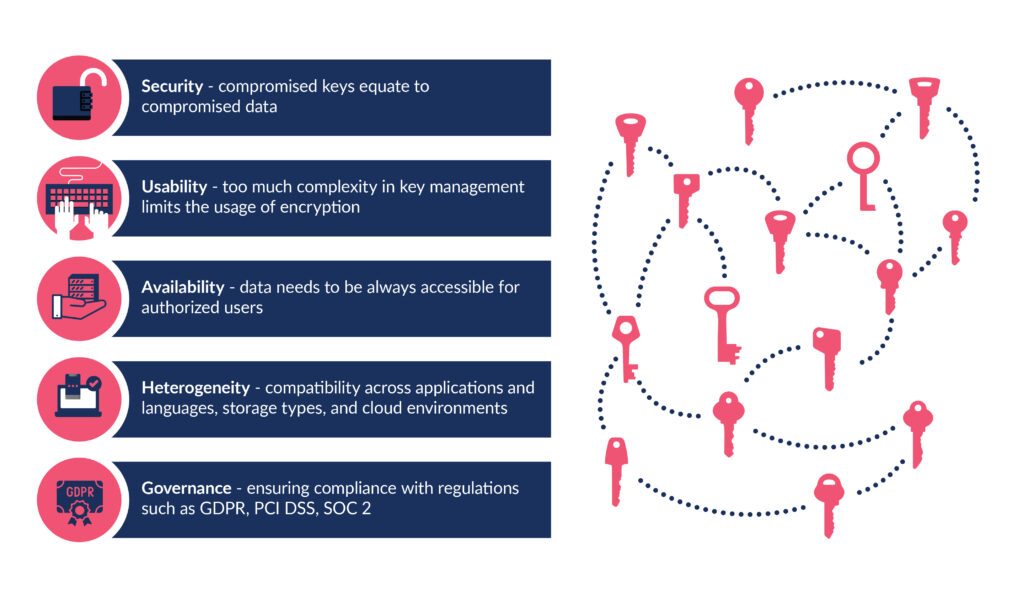
Five recurring enterprise key-management challenges: security, lifecycle complexity, availability, heterogeneous systems, and governance.

Strong cryptography can fail when keys are generated, stored, distributed, used, rotated, recovered, or destroyed incorrectly. NIST defines key management across the full lifecycle of cryptographic keys. Enterprise programs must make that lifecycle secure, available, auditable, and workable across many systems.
1. Security
Keys need protection at least as strong as the data and operations they control. Common failures include hardcoded keys, secrets committed to repositories, overly broad administrator access, shared credentials, unprotected backups, and keys exported into systems that do not need them.
Security controls should cover key generation, storage, distribution, use, backup, recovery, revocation, and destruction. Hardware or cloud HSMs can strengthen key custody, but they do not replace authorization, inventory, rotation, or application-level access design.
2. Lifecycle complexity
Keys have owners, purposes, cryptoperiods, versions, dependencies, and retirement conditions. A mature system must know which data was protected by which key, rotate without losing access to existing ciphertext, revoke compromised material, and migrate algorithms without creating an outage.
- Assign an owner and purpose to each key.
- Record creation, activation, rotation, retirement, and destruction events.
- Separate keys by environment, tenant, purpose, and algorithm where required.
- Test re-encryption, rollback, backup restoration, and emergency rotation.
3. Availability and recovery
If required key material is unavailable, protected data may become unavailable too. Availability planning needs redundancy, authenticated recovery, backup protection, disaster recovery, and clear handling for regional or provider failures.
Convenience shortcuts can create the opposite problem. Copying keys broadly, embedding them in applications, or extending caches indefinitely may improve availability while weakening the security boundary. Availability and security need to be designed together.
4. Heterogeneous systems
Enterprises use different clouds, databases, applications, languages, HSMs, vaults, standards, and legacy platforms. Each may represent key identifiers, metadata, rotation, and access controls differently.
The goal is not necessarily one physical key store for everything. It is consistent policy, inventory, evidence, separation of duties, and migration capability across the environment. Teams should know where keys exist, which workloads use them, and how a compromise or rotation propagates.
5. Governance and accountability
Governance connects technical controls to business ownership, internal policy, contracts, and regulatory obligations. Avoid reducing compliance to an algorithm name or key length. An approved cipher can still be deployed insecurely if keys are exposed, nonces repeat, access is excessive, or rotation cannot be completed.
Useful evidence includes:
- Key inventory and ownership
- Access approvals and separation of duties
- Rotation, revocation, backup, and recovery tests
- Cryptographic configuration and library versions
- Logs for key administration and protected-data operations
- Exceptions with expiration dates and accountable owners
Key management is necessary, but it is not runtime authorization
A KMS, vault, or HSM protects and controls cryptographic key material. That is different from deciding what sensitive data a requesting identity should receive. A service may be allowed to invoke a key while still being overprivileged for a particular field, record, or purpose.
Organizations therefore need both key-management controls and data-specific policy. The customer’s identity system establishes the requester. Runtime policy determines whether that identity receives authorized cleartext or a protected representation.
Practical key-management checklist
- Inventory keys, owners, purposes, algorithms, locations, and dependent data.
- Remove hardcoded, shared, and unowned keys.
- Use cryptographically secure generation and approved storage mechanisms.
- Restrict administrative and runtime access separately.
- Define cryptoperiods and compromise-driven rotation triggers.
- Test backup, recovery, revocation, and re-encryption.
- Monitor administrative changes and unusual key use.
- Design for algorithm and provider migration.
The bottom line
The hardest key-management problems are organizational as well as cryptographic. Security, lifecycle automation, availability, heterogeneous infrastructure, and governance must work as one system. Strong keys cannot compensate for weak ownership or excessive access.
For implementation detail, see NIST’s key-management guidance. To understand how key operations connect to identity-specific data outcomes, explore Runtime Data Protection.