
Data Security Insights
Capital One Breach Lessons for Protecting Sensitive Data
The 2019 Capital One incident shows why least privilege, cloud configuration, field-level protection, and authorization boundaries must work together.

The Capital One breach is not proof that one security control would have prevented the incident. It is a useful example of how cloud configuration, excessive permissions, application access paths, and data-protection boundaries can combine to increase exposure.
Capital One reported in 2019 that an outside individual obtained unauthorized access to personal information associated with approximately 100 million people in the United States and 6 million in Canada. The company stated that it routinely encrypted data, but the circumstances of the incident also enabled unauthorized decryption of some information.
What happened
Public reporting and legal proceedings described a server-side request forgery path that was used to obtain cloud credentials and access data stored in Amazon S3. The incident highlighted a familiar cloud-security failure mode: a compromised component can inherit permissions that reach far beyond what it needs to perform its function.
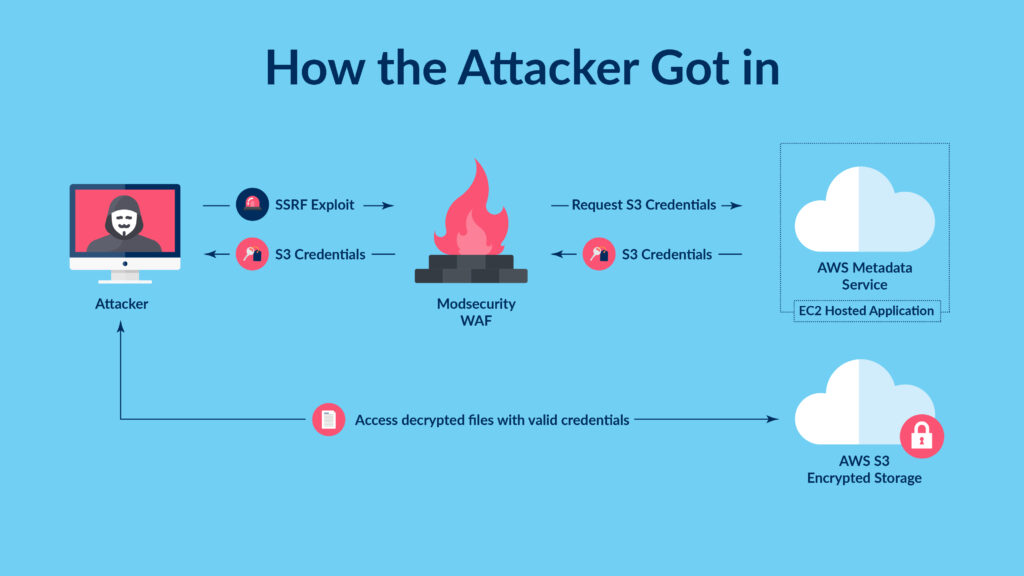
Lesson 1: Least privilege must cover human and non-human identities
Applications, services, cloud roles, automation, and security tools should receive only the permissions required for their function. A security component should not automatically inherit broad access to sensitive datasets simply because it operates inside a trusted environment.
Least privilege also needs continuous ownership. Permissions accumulate as systems evolve, teams change, and emergency access becomes permanent. Organizations need an inventory of which identities can reach sensitive data and a process for reviewing whether that access is still justified.
Lesson 2: Storage encryption is not an authorization boundary
Disk, volume, database, and object-storage encryption protect important threat scenarios, including lost media and access to raw storage. They do not necessarily protect data after an authorized service requests and receives a decrypted value.
If a compromised identity can invoke the normal decryption path, the system may correctly decrypt data for the wrong purpose. Protection therefore needs to address both how data is stored and what each requesting identity is allowed to receive at runtime.
Lesson 3: Field-level protection can reduce exposure
Protecting sensitive values before they reach a storage layer can reduce the amount of usable cleartext available to a compromised database, storage service, log pipeline, or adjacent component. The value depends on keeping the protection keys and authorized decryption path outside the attacker’s effective permissions.
This is not a claim that application-level or field-level encryption alone would have prevented the Capital One incident. The outcome depends on architecture, identity, key access, authorization policy, caching, and the exact systems compromised. It is more accurate to say that strong data-level separation can reduce the blast radius of some credential and infrastructure compromises.
Lesson 4: Protected data still needs governance
Encryption does not eliminate breach-response or notification obligations automatically. Legal requirements vary by jurisdiction, data type, encryption implementation, key exposure, and the facts of the incident. Organizations should involve privacy and legal teams rather than assuming encrypted data is categorically exempt.
Practical controls to review
- Map sensitive datasets to every human and non-human identity that can access them.
- Reduce cloud role and service permissions to the minimum required scope.
- Separate storage access from authorization to receive cleartext.
- Protect high-impact fields before they enter broadly accessible storage and data pipelines.
- Keep key access, decryption rights, and application permissions independently reviewable.
- Log and alert on unusual access volume, new access paths, and policy changes.
- Test whether a compromised component can obtain cleartext through normal application workflows.
- Review caches, backups, exports, logs, and analytics systems for secondary cleartext copies.
The bottom line
The Capital One incident illustrates why organizations need more than perimeter controls and storage encryption. Reducing exposure requires least privilege, accurate access mapping, field-level protection where appropriate, and runtime policy that determines what each identity can receive.
Learn how Ubiq applies identity and data policy through Runtime Data Protection.